How to Calculate Love Percentage on Paper
How to calculate love percentage on paper: the four-step method with every digit shown, and why your hand result rarely matches a calculator's.
بقلم Kunal Bansal ·
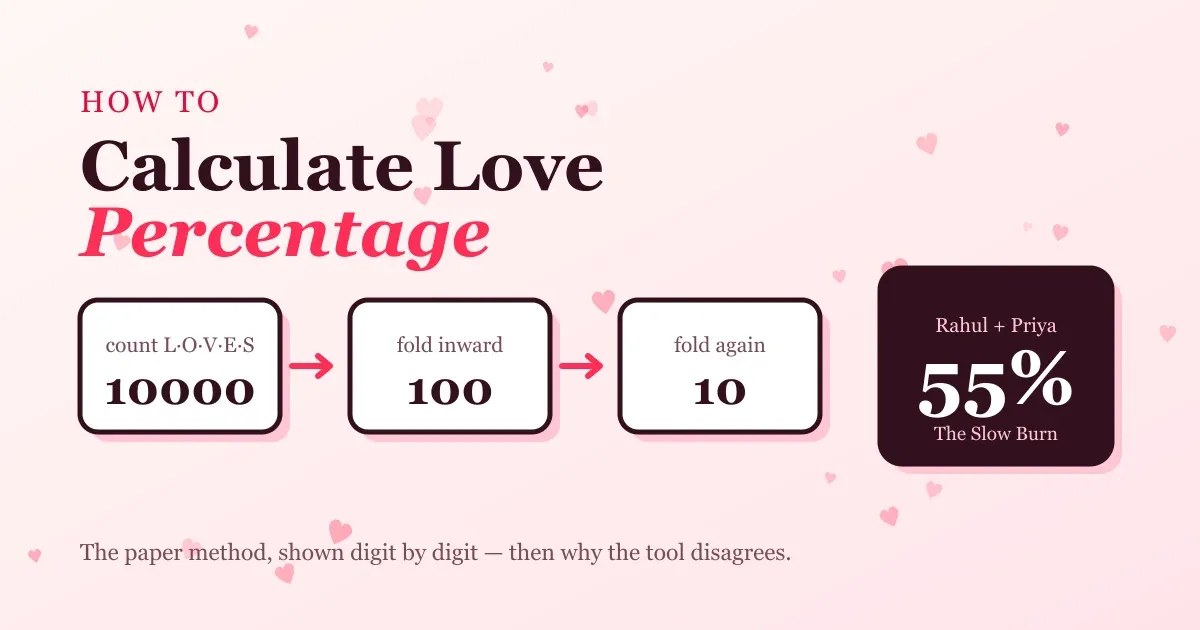
To calculate love percentage on paper, write both names down, count how often the letters of the word “loves” appear across them, then fold those five digits inward until two remain. That two-digit number is the score the playground version of this game has produced since long before any website existed.
This guide shows every intermediate number, not just the instruction to keep adding. It also answers the question the other guides leave hanging: why the number you work out by hand is usually not the number a calculator returns.
The love calculation formula below needs no website. Running a love calculator on paper takes a pen and about a minute, and the steps are identical to the ones any name-based tool starts from.
How to calculate love percentage on paper in four steps
Write both names, count the letters of “loves” across them, fold the digits inward, and read the two digits that survive. Steps 1 to 4 below run in that order and need nothing but a pen.
-
Tidy the letters
Write both names in lower case. Drop spaces, hyphens, apostrophes and accents so José-María becomes josemaria.
-
Count L, O, V, E, S
Go through the combined letters once per target letter and tally how many times each of the five appears.
-
Fold the digits inward
Add the first digit to the last, the second to the second-last, and keep folding the shorter result until two digits remain.
-
Read the two digits
The surviving pair is your percentage. It falls somewhere between 00 and 99.
Step 1: Write both names and tidy the letters
Tidying means stripping everything that is not a letter, then lower-casing what remains. Punctuation and capitalisation carry no value in this method, so they are removed before any counting starts.
Take Rahul and Priya. Both names are already plain, so they stay as rahul and priya. Sort the two alphabetically and join them, which gives priyarahul. Sorting matters if you want the same answer whichever name you write first.
Step 2: Count the letters of “loves”
Counting means tallying each of the five letters L, O, V, E and S across the combined string. Take one letter at a time and work through the whole string before moving to the next.
For priyarahul the tally is short:
| Letter | Occurrences in priyarahul |
|---|---|
| L | 1 |
| O | 0 |
| V | 0 |
| E | 0 |
| S | 0 |
Written in order, those five counts give the starting number 10000.
Most name pairs produce a sparse row like this one. The letters V and S are uncommon in first names, so a great many pairs start from a number with three or four zeros in it.
Step 3: Fold the digits inward
Folding means adding the outermost digits together, working inward, and repeating on each shorter result until two digits are left. A digit in the middle with no partner is carried down unchanged.
Here is the fold for 10000, in full:
| Pass | Digits | Pairs added | Result |
|---|---|---|---|
| Start | 1 0 0 0 0 | — | 10000 |
| Pass 1 | 1 0 0 0 0 | 1+0 = 1, 0+0 = 0, middle 0 carried | 100 |
| Pass 2 | 1 0 0 | 1+0 = 1, middle 0 carried | 10 |
Two digits remain after the second pass, so the fold stops. The base number for Rahul and Priya is 10.
If a pair of digits adds to 10 or more, write both digits of that sum into the next row rather than carrying anything. 7+8 becomes the two digits 1 and 5, not 15 treated as one value.
A full worked example: Rahul and Priya
The complete run for this pair takes four passes from names to final score.
| Stage | Value |
|---|---|
| Names tidied | rahul / priya |
| Sorted and joined | priyarahul |
| L·O·V·E·S counts | 1 · 0 · 0 · 0 · 0 |
| Starting number | 10000 |
| After fold | 10 |
| Score on paper | 10% |
On paper, Rahul and Priya score 10%. Our love calculator by name returns 55% for the same two names. Both numbers are correct for the method that produced them, and the next section explains the gap.
Why your paper answer and an online answer disagree
They disagree because the paper method is one reading and a full calculator blends four. The fold is the oldest of the four and carries the most weight, but on its own it throws away most of what two names contain.
A widely shared guide works through ALEX and MIA and arrives at 11%. That figure is right for the fold — alexmia gives counts of 1, 0, 0, 1, 0, which folds 10010 → 110 → 11. What that guide calls the love percentage is the base number, before anything else has been measured.
Our calculator takes the same base and adds three more readings:
| Reading | Weight | What it measures |
|---|---|---|
| LOVES fold | 38% | The traditional letter count |
| Harmony index | 34% | How the two names sit against each other |
| Texture | 16% | Vowel balance and shared letters |
| Numerology | 12% | The reduced number value of each name |
For Rahul and Priya those readings come out at a base of 10, a harmony index of 29 and a texture of 76. Blended at the weights above they land at 43.51, which converts to a final 55%.
Doing it on paper at school
The paper version needs two names, a pen and about a minute. It survives because it needs nothing else — no phone, no signal, no website.
This is how most people learn to find love percentage in the first place. Knowing how to calculate love percentage on paper is also the only way to check what a website is doing, because a tool that hides its method can claim anything.
The love calculator game on paper follows three conventions that have travelled with it:
- Use first names. That is how the game is written down in nearly every version of it.
- Write the names on one line before counting, so no letter is missed at the join.
- Count one letter at a time across the whole string, rather than reading the string once and trying to track five tallies at once.
Running a love calculator by name on paper produces the base number and stops there. The paper version has no way to weigh anything else, which is the whole of the difference between it and a full tool.
The same notebook page usually carries FLAMES next to it, which crosses out shared letters and counts what is left over. FLAMES answers a different question and returns a word rather than a number, so the two games do not compete. Our FLAMES calculator plays it properly if you want the letter version.
What the manual method cannot measure
The manual method cannot measure vowel balance, shared letters, or name numerology, because none of those quantities appears anywhere in the fold.
Three limits follow from that:
- It has 100 possible outputs. Every pair of names in the world resolves to one of 00 to 99, and most cluster low because V and S are rare letters.
- It ignores letters that are not in “loves”. The letters R, H, U, P, I, Y and A in
priyarahulcontribute nothing at all. - It cannot separate similar pairs. Two very different name pairs frequently return the same base, because the tally only ever looks at five letters.
Name numerology is the one missing piece you can still work out by hand. It assigns a number to every letter and reduces the total to a single digit, which is a different calculation with its own chart. Our numerology love calculator runs both the Pythagorean and Chaldean versions and shows the letter values it used.
100
possible paper results
00 to 99
5
letters actually counted
L, O, V, E, S
61%
median calculator score
measured across 1,600 pairs
Is the hand-calculated percentage accurate?
No arrangement of letters measures a relationship, and that is as true of the paper method as of any website. The fold is arithmetic on spelling, and spelling is not evidence about two people.
What the paper method does have is repeatability. Run it twice on the same two names and it gives the same answer both times, which is more than a number of online tools manage. That property is worth understanding before trusting any calculator, and our honest answer on accuracy covers how to test one in about fifteen seconds.
Check your paper answer against the full method
Type the same two names you just worked out by hand. The calculator shows the blended score, and the arithmetic behind it is published in full.
Open the love calculatorFrequently asked questions
How do you calculate love percentage on paper?
Write both names in lower case with no spaces, count how often each letter of the word loves appears across them, then add the outermost digits inward until two digits remain. Those two digits are the percentage.
What is the love calculator formula?
The traditional formula counts the letters L, O, V, E and S across both names and folds the five resulting digits inward until two remain. Fuller calculators add separate readings for vowel balance, shared letters and name numerology on top of that fold.
Why does my paper answer differ from the website?
The paper method produces only the fold, which is one of four readings a full calculator blends. On this site the fold carries 38% of the final score, so a paper answer and a calculator answer are rarely the same number.
Should I use full names or first names?
Use first names for the paper game, because that is how the method is written down almost everywhere. Adding surnames changes the letter counts and therefore changes the result.
Does the order of the names change the result?
No, provided you sort the two names alphabetically before joining them. Without sorting, the two orders can fold to different numbers.
Can the paper method give 100%?
No. The fold stops at two digits, so its highest possible output is 99.
How do you do the love calculator game on paper?
Write both first names on one line, tally the letters L, O, V, E and S across them, then fold the five digits inward until two remain. The paper version needs a pen and about a minute, and it produces the base number that fuller calculators start from.
Is the paper version the same as the one on this website?
No. The love calculator paper version produces only the LOVES fold, which carries 38% of the score here. The remaining 62% comes from the harmony index, vowel balance with shared letters, and name numerology, none of which can be worked out with the fold alone.